
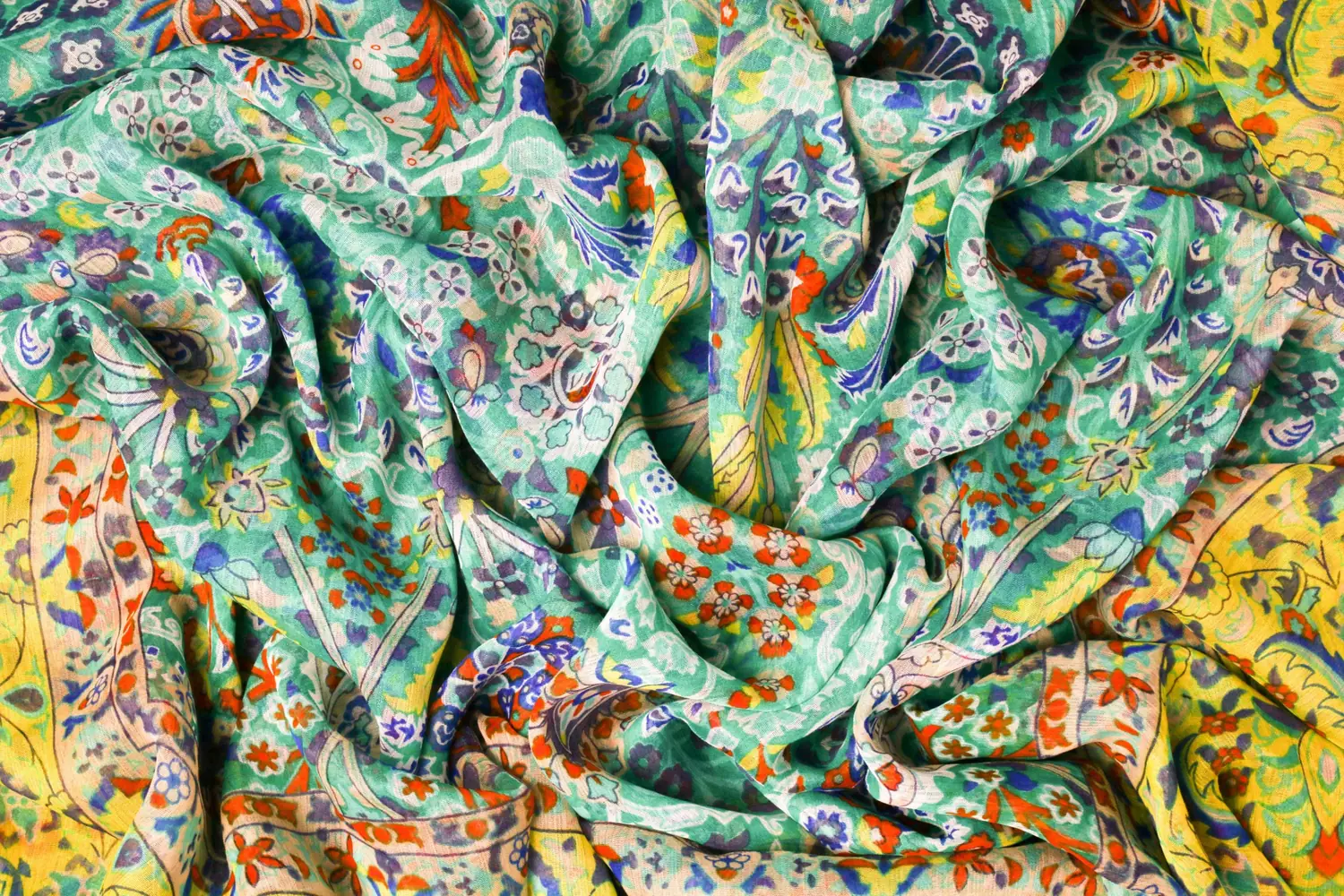
A saree is one of the most demanding products a textile printer makes. A single piece carries three different design zones: the body, the border running along its length, and the pallu at one end. Each zone has its own motif, colours and placement, and they all have to line up perfectly. Buyers also expect rich, deep colour that looks right on both sides of the drape.
That is why most commercial saree printers choose an automatic flatbed screen printing machine as their saree printing machine. This guide explains why flatbed printing suits sarees, how it handles each design zone and what to check before buying.
What Makes Saree Printing Different
- Multiple design zones: body, border and pallu each need their own design, and they must register accurately with each other.
- Placement, not just repeat: the pallu and border are positioned designs, not simple all-over repeats.
- Many colours: traditional and festive designs often use many colours with fine outlines and shading.
- Colour depth: sarees are seen from both sides when draped, so colour must penetrate well into the fabric.
- Wide fabric range: saree printers handle everything from lightweight georgette and chiffon to cotton, crepe and silk-like synthetics.
Why Flatbed Screen Printing Suits Sarees
Maximum Colour Penetration
The squeegee pushes a generous amount of paste through the screen and deep into the fabric, giving full, rich colour on both faces, exactly what a draped saree needs.
Flexible Repeat & Placement
Flatbed design repeat is not limited by a screen's circumference, as it is in rotary printing. This makes large pallu motifs and positioned borders easier to print.
Many Colours in One Pass
Each colour has its own screen position, so complex multi-colour saree designs print in a single pass on a machine with enough heads.
Fine Detail
Flatbed screens reproduce fine outlines, narrow lines and intricate motifs well, and multiple squeegee strokes give even colour on solid areas.
Economical for Design Variety
Saree collections change often and run in moderate quantities per design. Flatbed screens are practical for this mix of variety and volume.
Flatbed vs Rotary vs Digital for Saree Printing
| Flatbed screen | Rotary screen | Digital | |
|---|---|---|---|
| Colour penetration | Highest | Good | Lower, mostly surface |
| Repeat and placement | Flexible, not limited by screen circumference | Limited by screen circumference | Unlimited |
| Best run length | Medium to long runs per design | Very long runs | Sampling and short runs |
| Running cost per metre | Low | Lowest on long runs | Higher, mainly ink |
| Typical saree use | Production printing of body, border and pallu | Long runs of all-over body prints | Samples, short exclusive designs |
Many printers use more than one technology: digital for sampling and exclusive short runs, and flatbed for bulk production once a design sells.
What to Check in a Saree Printing Machine
- Printing width: matched to the saree fabric widths you print, with margin for other products.
- Number of colours: enough print heads for your most complex designs, plus a few extra for future collections.
- Table length and repeat: long enough for your pallu and border layouts.
- Registration accuracy: servo drives with closed-loop control hold border, pallu and body in register at full speed.
- Bed type: a soft bed for maximum penetration, or a hard bed with soft squeegee for sharper outlines with less penetration.
- Fabric handling: tension-free infeed and careful blanket gluing for lightweight georgette, chiffon and stretch fabrics.
- Fabric cleaning at the infeed: a brushing and cleaning unit removes lint before printing, preventing screen choke-ups on fine designs.
- After-sales support: local installation, operator training and fast spare parts.
Screenotex Flatbed Machines for Saree Printing
Screenotex builds three flatbed ranges, each configured to order for colours, table length and printing width:
| Specification | OPTIMA | ALTIMA | UNIQUE |
|---|---|---|---|
| Best for sarees when | You want the sharpest outlines and fine detail | You print wide fabrics and want maximum penetration | You are starting or scaling saree production |
| Max productivity | 1,440 m/hr | 1,200 m/hr | 1,080 m/hr |
| Max colours | Up to 42 | Up to 38 | Up to 18 |
| Max printing width | Up to 2,100 mm | Up to 3,550 mm | Up to 1,850 mm |
| Bed technology | Hard bed | Soft bed | Soft bed |
All three share a double servo drive, closed-loop motion control, an anti-vibration structure and HMI touchscreen control. They handle fabrics from lightweight chiffon to heavyweight cotton.
Conclusion
The best saree printing machine is the one that delivers deep colour, accurate registration across body, border and pallu, and the flexibility to handle constantly changing designs. For most commercial saree printers, that is an automatic flatbed screen printing machine, specified for the right width, colour count and bed type.
To find the right flatbed configuration for your saree production, explore Screenotex flatbed screen printing machines or contact our team.
Frequently Asked Questions
Which machine is best for saree printing?
For commercial saree production, an automatic flatbed screen printing machine is usually the best choice. It gives maximum colour penetration, flexible placement for border and pallu, and many colours in one pass.
Can a flatbed machine print saree borders and pallu in register?
Yes. A machine with servo drives and closed-loop control holds the registration of body, border and pallu designs at full production speed.
How many colours do I need for saree printing?
It depends on your designs. Many printers choose a machine with a few more heads than their current most complex design. Screenotex flatbed machines are available with up to 18, 38 or 42 colours.
Is digital printing better for sarees?
Digital printing suits samples and short exclusive runs. For bulk production with deep colour, flatbed screen printing is more economical per metre and gives better penetration.
Can the machine print georgette and chiffon sarees?
Yes, with tension-free infeed and careful blanket gluing. Screenotex flatbed machines handle fabrics from lightweight chiffon to heavyweight cotton.
Hard bed or soft bed for sarees?
A soft bed gives maximum colour penetration. A hard bed with a soft squeegee, as on the Screenotex OPTIMA, gives sharper outlines with less penetration.