
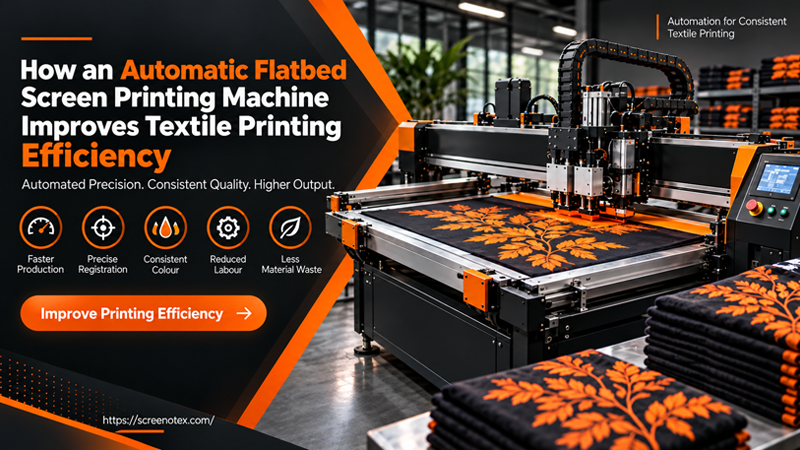
Manual screen printing has its place. For short runs, for artisanal production, for the kind of work where the hand of the printer is part of the product's value. But in commercial textile manufacturing, where the same design needs to be reproduced accurately across hundreds or thousands of metres of fabric, manual printing creates problems that compound at scale.
Operator fatigue changes print pressure over the course of a shift. Registration drifts as screens are repositioned manually time after time. Colour deposit varies with technique differences between operators. The second batch of five hundred metres does not quite match the first. A client who ordered fabric for a coordinated collection receives pieces that are not actually coordinated.
Automatic flatbed screen printing addresses these problems at their source by removing human variability from the repetitive stages of the process while keeping human judgement where it genuinely matters.
What Automation Actually Does
In a manual flatbed operation, the operator moves the squeegee across the screen, lifts the screen, repositions the fabric, and repeats. In an automatic system, these movements are mechanised. The squeegee stroke is controlled, consistent, and repeatable. Fabric advance between prints is precise. Screen registration is maintained mechanically rather than depending on an operator's hands and eyes.
The result is that once the machine is correctly set up for a job, every subsequent print in that run is produced under identical mechanical conditions. The same squeegee pressure, the same speed, the same ink deposit, the same registration position. Fabric that goes into the machine at hour one and fabric that comes out at hour eight have been printed to the same specification.
For textile manufacturers whose business depends on delivering consistent results, this repeatability is the central value of the technology. It is not that the machine prints faster than a skilled operator, though it often does. It is that the machine performs a repetitive physical task, hour after hour, without the natural variation a human operator introduces over a long shift.
Labour Utilisation Changes Meaningfully
This point deserves more attention than it usually receives in equipment discussions. Automation does not eliminate the need for people in a printing operation. It changes what those people are doing.
In a manual operation, a significant portion of the workforce is occupied performing the physical printing movements. Their attention is on those movements. Setup, quality monitoring, problem-solving, and production management compete for attention with the physical task.
In an automatic operation, the machine handles the physical repetition. The people are focused on setup, screen preparation, ink management, quality inspection, fabric handling, and keeping the machine running efficiently. This is skilled work that benefits from human judgement. The machine handles the repetitive mechanical work well; the people handle the thinking work that actually requires people.
Application Range and Configuration
Flatbed screen printing is not a single process. Different fabric types, inks, and design requirements produce different configuration needs. Fashion fabrics with fine design detail have different requirements from home textile printing with large repeat patterns. Reactive printing on natural fibres requires different process parameters from pigment printing on blended fabrics.
Before specifying a machine, the relevant questions are about the actual production requirements. What fabrics will be printed? What type of inks are used? How many colours are typically used in a design? What is the repeat size? What is the required production volume per shift? What level of registration accuracy does the design work demand?
These questions determine the right machine specification, rather than the other way around. A machine correctly specified for the actual application delivers on its efficiency promise. One selected based on available budget or familiarity with a particular supplier's product range, without adequate application matching, creates constraints that show up in production performance.
Process Control Remains Essential
Automation changes where the critical process control attention is needed. It does not eliminate the need for process discipline.
Screen quality matters more, not less, in an automatic operation, because the machine will faithfully reproduce whatever the screen contains, including any emulsion defects or mesh inconsistencies that a skilled manual printer might otherwise compensate for intuitively. Ink rheology needs to be managed carefully, since the machine applies ink at a fixed speed and pressure, so variations in viscosity translate directly into print quality variation. Fabric tension and feeding accuracy affect registration in the same way.
Getting these upstream factors right is what allows the machine's mechanical precision to translate into finished fabric quality. A poorly prepared screen run on an automatic machine simply produces poor prints more efficiently.