
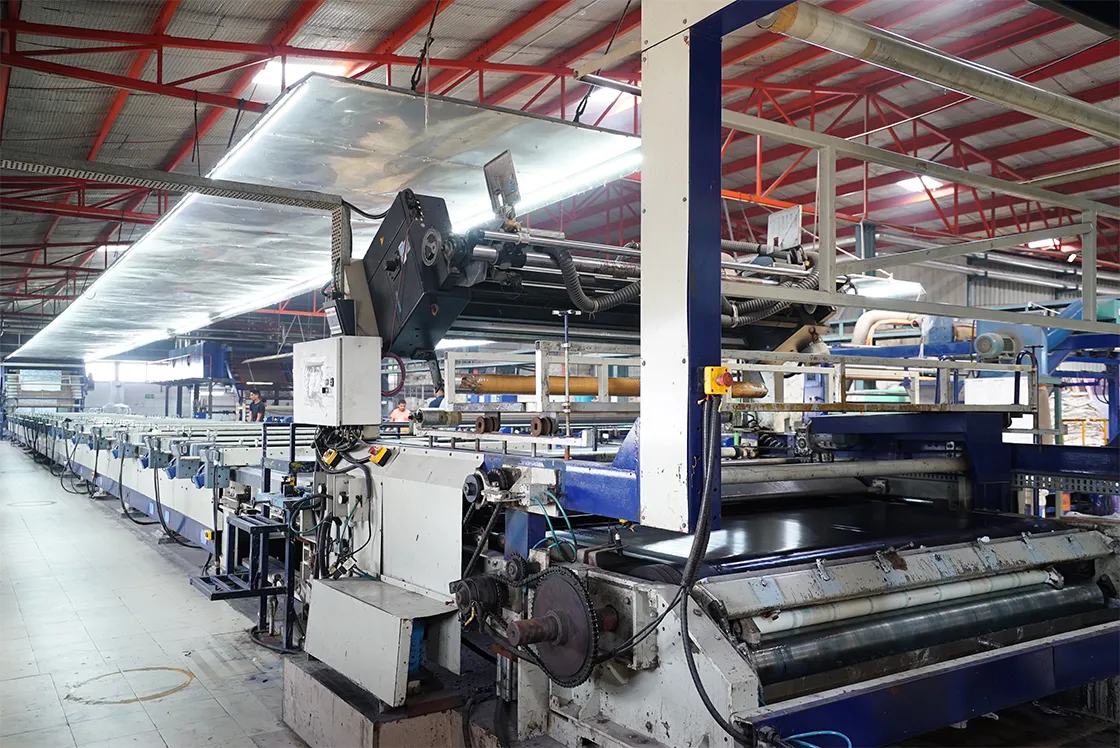
A flatbed screen printing machine is a long-term investment, and its specifications decide what you can print, how fast you can print it and how consistent the quality will be for years to come. Comparing machines on price alone often leads to a machine that is too narrow, has too few colours or cannot hold registration at production speed.
This guide explains the flat bed screen printing machine specifications that matter most, what each one means for your production, and how to match them to your fabrics and order book.
How Flatbed Screen Printing Works
In a flatbed screen printing machine, the fabric is glued onto a moving blanket (printing belt) that carries it along the printing table. Flat screens, one for each colour, are positioned over the table. The blanket advances the fabric by one repeat, stops, the screens lower and the squeegees print, then the screens lift and the cycle repeats. After the last colour, the fabric is lifted off the blanket and goes into the dryer, while the blanket is washed before the next cycle.
Because each colour is printed by a separate screen, the machine's accuracy in advancing the fabric and positioning the screens is what decides print quality.
The biggest strength of flatbed screen printing is colour penetration.
The squeegee pushes a generous amount of paste through the screen and deep into the fabric, giving rich, full colour that goes through the fabric rather than sitting on the surface. This is why flatbed printing remains the preferred choice for bedsheets, home textiles, flags and other products where colour must look equally strong on both sides.
Eleven Specifications to Check
Printing Width
The maximum printing width must suit the widest fabric you print, plus a margin for future products. Standard apparel fabrics need less width, while bedsheets, home textiles and flags need wide-width machines. Choosing a machine that is too narrow limits your product range; a machine that is much wider than needed adds unnecessary cost and floor space.
Number of Colours
The number of print heads (screen positions) decides how many colours you can print in one pass. More colours allow more complex designs and better shading. Many printers buy with a few extra positions so that they can take on more complex designs as their market grows.
Table Length
Table length is directly linked to the number of colours and the screen repeat. A longer table accommodates more print heads and allows longer repeats, but needs more floor space. Check the table length against your factory layout before finalising the colour count.
Production Speed
Flatbed speed is usually given in metres per hour. Remember that the rated maximum is achieved under ideal conditions, and actual output depends on repeat length, number of strokes, paste and fabric. Compare machines on a realistic speed for your typical designs, not only the headline figure.
Bed Technology: Hard Bed vs Soft Bed
The printing bed, together with the squeegee, decides how much the colour penetrates the fabric. This is one of the most important choices, because it should follow the print effect your customers want:
Soft Bed
The bed gives slightly under the squeegee pressure, pushing more paste into the fabric for maximum colour penetration. The right choice for most flatbed work, where deep, full colour is the priority.
Hard Bed + Soft Squeegee
The firm bed and soft squeegee keep more colour on the surface, so it penetrates less and gives sharper prints with crisp outlines and fine detail. The right choice when a customer wants the sharpest possible print.
Drive System and Registration Accuracy
Registration, the accuracy with which each colour lands in the right position, is the most important quality specification of a flatbed machine. It depends on the drive system:
- Servo drives for blanket advance and print heads give precise, repeatable movement at every speed.
- Closed-loop control with encoder feedback continuously corrects position errors, reducing repeat errors and colour misregistration.
- Rigid, anti-vibration construction keeps screens and table stable at high speed, protecting print sharpness.
Ask how the machine holds registration over long table lengths and at full speed, not only at low speed.
Squeegee, Lifting and Infeed Systems
Check how the print heads, screen lifting and fabric infeed are driven. Servo-driven systems offer the most precise control of squeegee pressure, speed and strokes, while inverter-driven and hydraulic systems offer a cost-effective option for standard production. A controlled infeed with proper tension management is essential for stretch and knitted fabrics.
Fabric Compatibility: Woven and Knitted
Woven Fabrics
Suit most configurations. A flat bed printing machine for woven fabric should focus on width, colours and registration for bedsheets, dress materials and home textiles.
Knitted Fabrics
Tension-free infeed, careful blanket gluing and controlled fabric handling are critical to avoid distortion and registration shift.
If you print both, make sure the machine's infeed and tension control can be adjusted for lightweight, stretch and heavyweight fabrics.
Automation and Controls
A fully automatic flat bed screen printing machine offers servo control of all main functions, with an HMI touchscreen to set speed, pressure, strokes and registration and to store design settings. Higher automation reduces dependence on skilled manual adjustment, shortens changeover time and gives more consistent quality across shifts. Diagnostics on the HMI also help maintenance teams prevent breakdowns.
Auxiliary Equipment
A flatbed machine works as part of a complete line. Check the blanket gluing and washing system, the dryer that follows the machine, and inline auxiliaries such as a fabric brushing and cleaning unit at the infeed, which removes dust and lint before printing and reduces screen choke-ups.
Service, Spares and Support
Finally, a specification sheet does not show the quality of after-sales support. Check the manufacturer's installation and commissioning support, operator training, spare-parts availability and service response time in your region.
Screenotex Flatbed Machines at a Glance
Screenotex builds three flatbed ranges, each configured to order for colours, table length and printing width:
| Specification | OPTIMA | ALTIMA | UNIQUE |
|---|---|---|---|
| Positioning | Sharp prints, maximum automation | Wide-width, maximum penetration | Entry to industrial scaling |
| Max productivity | 1440 m/hr | 1200 m/hr | 1080 m/hr |
| Max colours | Up to 42 | Up to 38 | Up to 18 |
| Max table length | Up to 76 m | Up to 67 m | Up to 40 m |
| Max printing width | Up to 2100 mm | Up to 3550 mm | Up to 1850 mm |
| Bed technology | Hard bed | Soft bed | Soft bed |
| Drive system | Double servo + closed loop | Double servo + closed loop | Double servo + closed loop |
| Printing heads | Servo driven | Inverter driven | Inverter driven |
| Lifting mechanism | Servo driven | Hydraulic or servo | Hydraulic or servo |
| Infeed system | Servo driven | Inverter driven | Inverter driven |
OPTIMA
The recommended choice when the customer wants sharp prints with less penetration. Hard bed and soft squeegee for crisp outlines and fine detail, with maximum automation: full servo synchronisation, HMI diagnostics and up to 42 colours.
ALTIMA
Handles wide fabrics up to 3550 mm and, with its soft bed, delivers the full colour penetration flatbed printing is known for. Ideal for bedsheets, home textiles and flags.
UNIQUE
The entry point for growing businesses and smaller runs, offering excellent return on investment.
All three share a double servo drive, closed-loop motion control, an anti-vibration structure and HMI touchscreen control, and handle fabrics from lightweight chiffon and stretch jersey to heavyweight canvas.
Conclusion
The right flatbed screen printing machine is the one whose specifications match your fabrics, designs and production volume today, with room to grow tomorrow. Printing width, colours, table length, bed type, drive system and automation should be evaluated together, along with the support you will receive after installation.
Screenotex Engineers can help you configure the right flatbed machine for your production. Explore our flatbed screen printing machines or contact our team.
Frequently Asked Questions
What are the key flat bed screen printing machine specifications?
The most important are printing width, bed type (which decides colour penetration vs sharpness), number of colours, table length, production speed, drive system and registration accuracy, fabric handling and automation level.
What is the difference between a hard bed and a soft bed?
A soft bed gives maximum colour penetration into the fabric, which is the main strength of flatbed printing. A hard bed with a soft squeegee keeps more colour on the surface, giving less penetration and sharper prints, which is why Screenotex recommends the OPTIMA when sharpness matters more than penetration.
Why is registration accuracy important?
Each colour is printed by a separate screen, so accurate registration ensures every colour lands in exactly the right position. Servo drives with closed-loop control give the most consistent registration at full speed.
Can a flatbed machine print both woven and knitted fabrics?
Yes, provided the infeed and tension control suit stretch fabrics. Knitted fabrics need tension-free feeding and careful handling to avoid distortion.
Should I choose a fully automatic flat bed screen printing machine?
For high volumes, many colours and multi-shift production, full servo automation gives more consistent quality and less dependence on skilled manual adjustment. For smaller runs, a standard automation level can offer better return on investment.
How many colours can a Screenotex flatbed machine print?
Depending on the model and configuration, Screenotex flatbed machines print up to 18, 38 or 42 colours.