
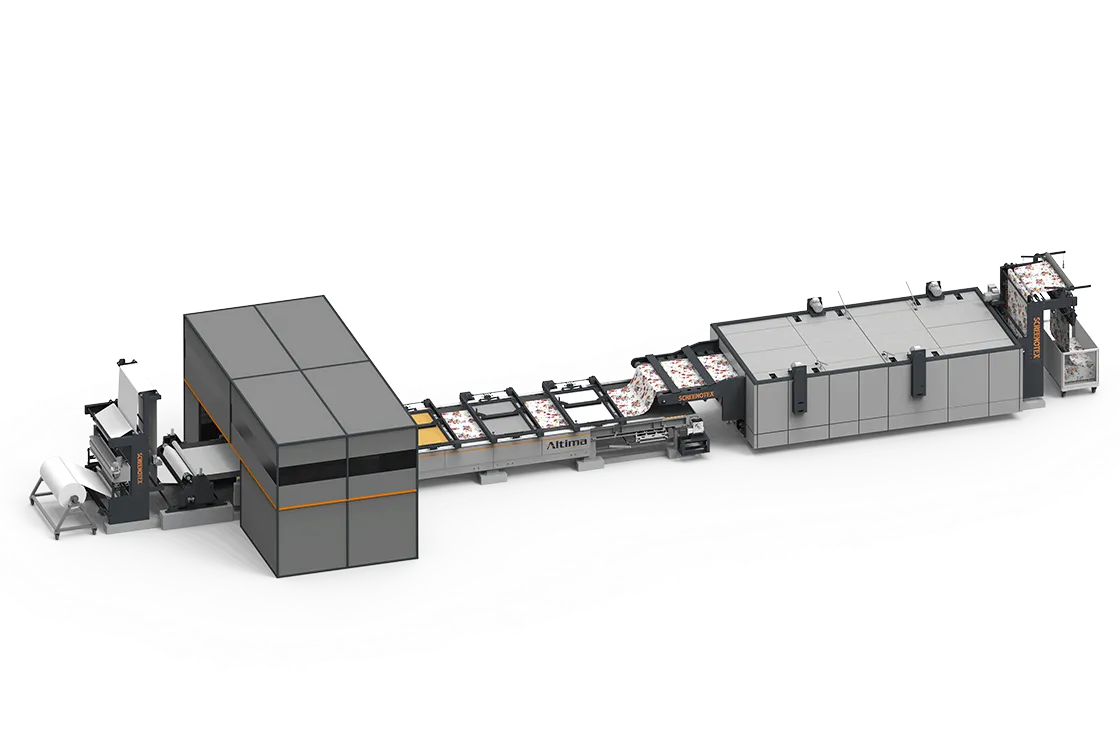
Digital printing brings unlimited colours and design freedom. Flatbed screen printing brings rich special effects, solid grounds and heavy paste deposits that inkjet heads cannot match. Until now, combining the two meant printing on one machine, rolling the fabric up and running it again on another, with all the cost, handling and registration problems that come with a second run.
A hybrid digital screen printing machine removes that second run. As a hybrid fabric printing machine manufacturer in India, Screenotex Engineers has built a single inline line that combines digital inkjet printing and flatbed screen printing, so both are applied in one pass, perfectly registered to each other.
What Is a Hybrid Printing Machine?
A hybrid printing machine combines a digital inkjet printing section and a flatbed screen printing section on one continuous fabric path. The fabric is fed once, printed digitally and printed by screen in the same pass, and then goes directly into the dryer.
The control system registers the digital print and the screen print to each other, so effects printed by screen land exactly where the digital design needs them, without the misalignment that occurs when fabric is printed on two separate machines.
How the Screenotex Hybrid Line Works
Infeed & Preparation
Fabric is fed from the roll with tension-free guiding at a controlled speed.
Digital Section
High-resolution digital heads print the full-colour design, synchronised with the flatbed section for registration.
Flatbed Section
Screen stations apply special-effect pastes, solid backgrounds, additional colours or pre-treatment, depending on the job.
Dryer & Outfeed
The printed fabric passes directly into a Screenotex dryer (float, horizontal conveyor or FHCD) before winding.
Three Machines in One: Operating Modes
One of the biggest advantages of the hybrid line is that it is not limited to hybrid work. It can run in three modes, so the machine stays productive whatever the order book looks like:
Digital Only
The digital section runs on its own for full-colour, multi-colour and complex designs with unlimited repeat lengths. The screen stations stay inactive.
Hybrid Combined
Both sections run together in a single pass. The digital section prints the full-colour design while the flatbed stations add special effects, solid grounds or value-added pastes.
Flatbed Only
The line runs as a standalone flatbed screen printing machine for heavy paste volumes, solid backgrounds or designs that need multiple squeegee strokes.
What You Can Print With Hybrid Technology
Hybrid printing opens up products that neither digital nor screen printing can produce efficiently on its own:
Effects on Digital Prints
Metallic, foil binder, glitter, puff, discharge, devoré and khadi effects applied over a digital design in the same pass.
Solid Grounds, Digital Detail
Large solid background areas printed by screen, with the digital section handling fine detail, gradients and photographic elements.
Lower Ink Cost
Solid fills are printed with economical screen paste instead of expensive digital ink, reducing cost per metre on heavy designs.
Higher-Value Fabrics
Digital artwork with screen-printed effects creates premium products for fashion, ethnic wear and home textiles.
Benefits of a Hybrid Digital Screen Printing Machine
- One line instead of two: lower capital cost, less floor space, fewer operators and lower maintenance than running separate digital and screen lines.
- No second printing run: eliminates re-handling, re-loading and the extra time of printing the fabric twice.
- Accurate registration: digital and screen outputs are registered by the control system, removing the alignment errors common between separate machines.
- Unlimited design repeat: the digital design repeat is not limited by screen size.
- Consistent fabric transport: tension-free fabric handling keeps delivery speed consistent across both sections, reducing stretch and registration shift.
- Maximum machine utilisation: three operating modes keep the line productive across digital, screen and combined orders.
Eliminate the second printing run, and with it the re-handling, re-loading and registration errors.
Flexible Configuration to Suit Your Production
Every Screenotex hybrid line is configured at the time of order:
Flatbed Screen Stations
From a single station for one special effect up to a full multi-colour setup.
Digital Ink System
Reactive, disperse, acid or pigment inks, to suit cotton, polyester, silk, wool, nylon and blends.
Flatbed Pastes
Standard screen printing paste systems, including specialty effect pastes.
Fabric Width
Specified at order and common to both sections.
Dryer
Connects directly to a Screenotex float, horizontal conveyor or FHCD dryer.
Choosing a Hybrid Printing Machine Manufacturer in India
A hybrid machine is only as good as the integration between its digital and screen sections. When choosing a manufacturer, printers should look for:
- Proven flatbed screen printing engineering
- Precise synchronisation and registration between the two sections
- A choice of ink systems and dryers
- Strong installation, training and service support covering both technologies
The hybrid line is built on our proven flatbed screen printing platform and designed, manufactured and supported from our Ahmedabad facility.
Conclusion
Hybrid printing gives textile printers the design freedom of digital printing and the effects and economy of flatbed screen printing in a single machine and a single pass. With three operating modes, accurate registration and flexible configuration, it allows printers to produce higher-value fabrics while saving the cost, space and time of running two separate lines.
To configure a hybrid printing line for your production, request a call from a Screenotex engineer.
Frequently Asked Questions
What is a hybrid printing machine?
It is a single inline machine that combines a digital inkjet printing section with a flatbed screen printing section, so both can print on the fabric in one pass.
What are the advantages of hybrid printing over separate digital and screen machines?
A hybrid line eliminates the second printing run, keeps digital and screen prints accurately registered, and saves capital cost, floor space, operators and maintenance compared with running two separate lines.
Can the hybrid machine be used for digital printing or screen printing alone?
Yes. It can run in digital-only, flatbed-only or hybrid combined mode, depending on the order.
What special effects can be printed with a hybrid machine?
The flatbed section can apply metallic, foil binder, glitter, puff, discharge, devoré and khadi effects, as well as solid grounds and additional colours.
Which inks can be used in the digital section?
The digital section can be configured for reactive, disperse, acid or pigment inks, depending on the fabrics you print.
Does hybrid printing reduce printing cost?
On high-coverage designs, yes. Solid areas can be printed with screen paste instead of digital ink, which lowers ink cost per metre, and a single pass reduces handling and processing costs.