
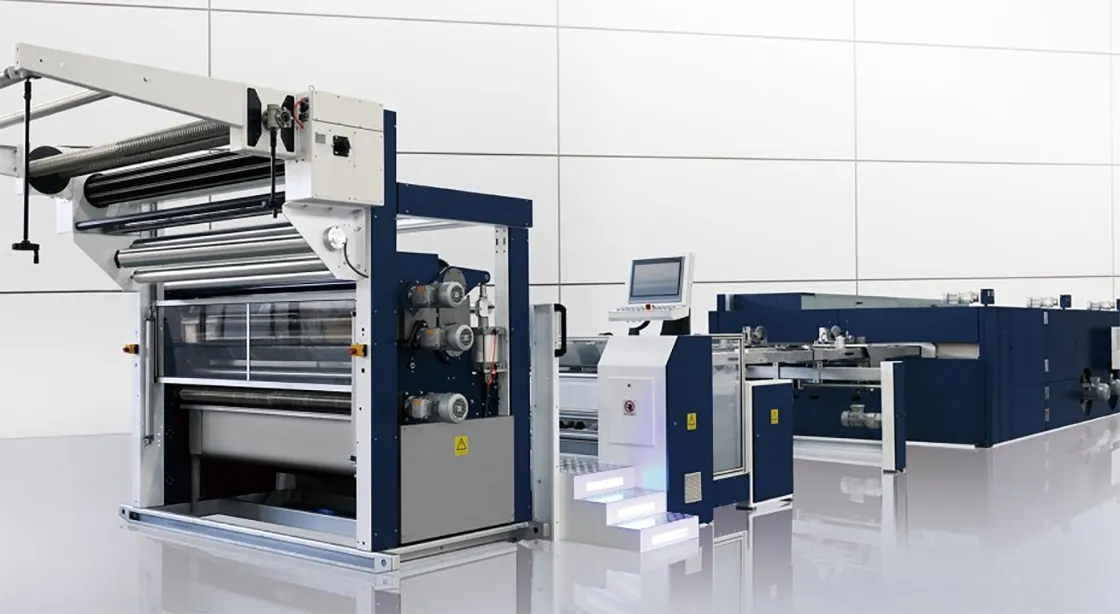
Textile finishing is what turns processed fabric into a stable, usable material, and few machines are as central to that stage as the stenter. A stenter controls fabric width, applies controlled drying and heat treatment, and stabilises the fabric's dimensions before it moves on to cutting, coating, or dispatch.
Understanding how a stenter actually works helps textile companies evaluate where it fits into their finishing line, and what to look for when specifying one.
What Is a Stenter Machine?
A stenter (also called a stentering machine or tenter frame) is textile finishing equipment that holds fabric at a controlled width while passing it through a heated chamber. As the fabric travels through the machine, it is dried, heat-set, and stabilised to the required dimensions, correcting for the shrinkage or distortion introduced in earlier wet processes like dyeing, washing, or coating.
Stenters are built around three core functions: width control, controlled heating, and continuous fabric transport. Machines are configured with steam, gas-fired, or thermic-fluid heating, with chamber length, clip/pin chain design, and drying capacity matched to the fabric type and output volume.
Stenter Machine Working Principle
The fabric's edges are held by a moving chain of clips or pins on either side of the machine, which keeps the fabric under controlled width and tension as it travels continuously through a heated treatment zone.
Entry
Fabric is fed in and aligned so both edges engage the clip or pin chains evenly. The chains diverge or converge to widen or narrow the fabric to the target dimension.
Heating Chambers
Hot air circulates across the fabric to dry it and, where required, heat-set it. Temperature, dwell time, and airflow are set to the fabric type and finishing objective.
Cooling & Delivery
After the final chamber, the fabric passes through a cooling zone before the clips or pins release it for inspection or the next process step.
The chain movement at entry is what allows a stenter to correct for width distortion picked up in earlier processing. Chamber settings determine whether the fabric is simply dried or undergoes the more demanding heat-setting process.
Importance of Heat Setting
Heat setting is a higher-temperature stage of stenter processing used mainly on synthetic and synthetic-blend fabrics, polyester in particular. It heats the fabric above its glass transition temperature for a controlled dwell time, relaxing internal fibre stresses and locking the fabric into a stable dimensional state. A properly heat-set fabric resists shrinkage and distortion in later processing and in the finished product.
Getting it wrong in either direction causes real problems. Insufficient temperature or dwell time leaves the fabric under-stabilised, so it continues to shrink or distort later. Excessive temperature can degrade fibre strength, affect hand feel, or cause dye shade changes.
Temperature, line speed, and dwell time need to be set for the fabric being processed, not run on generic settings.
Different Heating Options
Stenter machines are built with different heating systems. The right choice depends on fuel availability, operating cost, and the level of temperature control the fabric requires.
Steam-Heated
Uses steam from an existing boiler through heat exchangers or radiator coils. Convenient and lower-cost where that infrastructure exists, but generally limited to around 150–180°C, which can fall short of the 190–220°C needed to heat-set polyester.
Gas-Fired
Heats circulating air with a gas burner, directly or through a heat exchanger. Faster heat-up and lower running costs where natural gas or LPG is available; combustion must be well controlled to avoid uneven heating or contamination.
Thermic-Fluid-Heated
A closed-loop heat transfer fluid, heated centrally and circulated through chamber heat exchangers. Stable, precise temperature control for sensitive fabrics, with the added capital and operating cost of the central heater.
The right choice depends on the fabric range, the temperature precision the finishing process demands, and the fuel or utility infrastructure already available at the plant.
Applications in Textile Finishing
Stenters are typically positioned after wet processing stages (washing, dyeing, printing, or coating), where fabric width and shape have been disturbed by tension, moisture, and handling. Common applications include:
- Drying fabric after dyeing or washing
- Heat-setting synthetic and blended fabrics
- Applying finishing chemicals via a padder ahead of the stenter, and curing them in the chamber
- Correcting bow and skew, where the weft runs diagonally instead of straight across the width
The configuration required (chamber count, heating type, width range, and padding or coating attachments) depends on which of these applications the line is built around.
Choosing the Right Stenter Machine
Before selecting equipment, textile manufacturers should assess:
Production Width
Matched to current fabric widths, with allowance for future range expansion.
Fabric & Fibre
Heat-setting requirements differ significantly between synthetics, natural fibres, and blends.
Heating
Based on fuel availability, running cost, and required temperature precision.
Operating Speed
Matched to the finishing process and required chamber dwell time.
Production Space
Chamber count and machine length scale with the drying and curing capacity needed.
Maintenance and service matter just as much as the initial specification. A stenter runs continuously under heat and mechanical load, so chain and clip wear, burner or heat exchanger maintenance, and temperature control calibration all need ongoing attention. Proper maintenance planning supports stable operation and reduces unplanned production interruptions.
Conclusion
Understanding how a stenter holds and widths fabric, applies controlled heat, and stabilises dimensions makes it easier to specify the right configuration for a finishing line, rather than choosing on price or familiarity alone. Matching the heating system, chamber capacity, and width range to the actual fabric and process requirements determines whether it delivers consistent, stable finished fabric over its operating life.
Screenotex brings over three decades of textile printing and finishing machinery engineering to every equipment recommendation we make, and stenter machines are part of the finishing equipment we offer. Speak with our team to discuss the right stenter configuration for your fabric range and production line.
Frequently Asked Questions
What is the main function of a stenter machine?
A stenter is used for textile finishing processes involving fabric width control, drying, heat setting, and related finishing operations such as chemical curing after padding.
How does a stenter hold fabric?
The fabric edges are held using a moving chain of clips or pins on either side of the machine, which controls fabric width and tension as it travels continuously through the treatment chambers.
What is heat setting in textiles?
Heat setting is a controlled, higher-temperature treatment used mainly on synthetic and blended fabrics to relax internal fibre stresses and stabilise dimensions, reducing shrinkage and distortion in later processing or end use.
What types of stenter heating systems are available?
The main categories are steam, gas-fired, and thermic-fluid-heated stenter machines. Each differs in heat-up speed, running cost, and temperature control precision, and the right choice depends on fuel availability and the fabric being processed.